
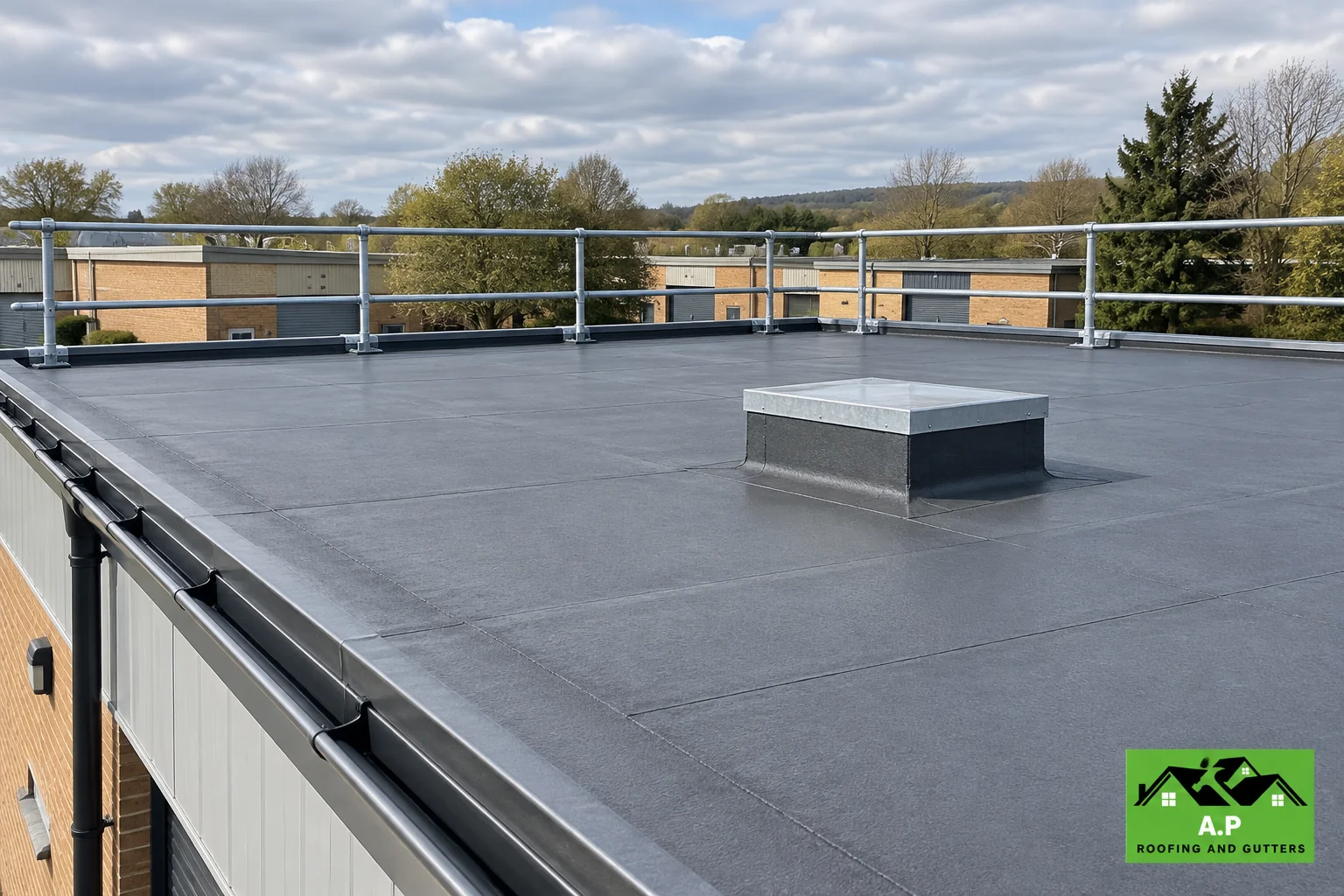
Industrial roofs often combine large spans, sheeted coverings, rooflights, internal gutters and significant access risks. The waterproofing issue may look simple from the factory floor, but safe investigation and repair can be more complex than the leak itself.
We approach industrial roofing around Crawley with careful assessment of roof fragility, drainage, penetrations, corrosion and the operational needs of the site.
Treating sheeted roofs and rooflights as fragile
HSE guidance says roofs should be treated as fragile until a competent person confirms otherwise. Fibre-cement sheets, corroded metal and rooflights are particular hazards, and old rooflights can be difficult to distinguish from surrounding material.
That means access planning, edge protection and fall prevention are fundamental to the job, not optional additions after the quote.
Common industrial roof defects
Water can enter through laps, aged fixings, cracked rooflights, failed sealant, penetrations, valley gutters and corrosion around fasteners or sheet edges. Internal gutters can also overflow unseen until water appears inside the building.
The repair method depends on the sheet type, coating condition, substrate and whether the defect is local or part of system-wide ageing.
Refurbishment versus replacement
Coating and liquid refurbishment systems can extend service life where the substrate is suitable, while heavily corroded or brittle coverings may need more substantial replacement.
A refurbishment specification should include preparation, treatment of fixings and laps, details around rooflights and a drainage plan rather than only the coating of open sheet areas.

Working around an operational site
Industrial work may need exclusion zones, coordination with forklift routes, production shutdowns or controls around dust and falling objects. Roof access also has to account for plant, vents and live services.
We discuss those practical constraints early so the roofing method can fit the site rather than forcing the site around an unrealistic method.
Future inspection and maintenance access
Large roofs need repeatable maintenance. Clear routes to gutters, outlets and plant reduce the temptation for later trades to improvise unsafe access or walk across fragile areas.
Where a new or refurbished system is installed, maintenance requirements should be recorded for the building manager.
Establish what the roof is made from
Older industrial roofs can contain different generations of sheeting, coatings and rooflights. Some materials may be fragile or contain asbestos, so their identity cannot be guessed from ground-level appearance. Existing surveys and building records should be reviewed before intrusive work. Suspect material needs the appropriate specialist assessment and controls. A roof-over or coating proposal should not be used to avoid understanding the condition of the structure and covering beneath it.
Investigate laps, fixings and gutters together
Water entering a large roof may travel considerable distances before reaching the occupied space. Fixing washers, side and end laps, rooflight junctions, penetrations and valley gutters can all contribute. A repair specification should identify these details rather than cover the visible field with an unspecified coating. Where corrosion or deterioration is widespread, phased replacement may be more sensible than isolated patches. The decision depends on substrate suitability, remaining condition, access and the operational needs of the premises.
Agree the site arrangements
Exclusion zones, loading routes, welfare, emergency access and coordination with the building’s activities need planning. Tell us about sensitive stock, dust restrictions and services running through the roof. The final proposal should define the roofing work and any structural, electrical or specialist removal tasks required from others.
Questions homeowners often ask
Yes, depending on sheet condition and safe access. Fixings, laps, penetrations and internal gutters are common investigation points.
They should be treated as fragile. HSE guidance requires work near fragile surfaces to be planned with suitable protection and safe access.
Sometimes. The substrate, corrosion, existing coating, laps, fixings and rooflight condition must support a refurbishment system; coating should not be used to hide structurally unsound material.
Technical guidance and further reading
What affects the size and cost of the job?
Reroofing costs depend on what is being rebuilt, not just what is visible at the end. Strip-off, access, waste, hidden layers, roof geometry, insulation and structural repairs can create a large difference between two projects that look similar from the street.
- Total roof area, height, pitch and complexity
- Scaffold and site-access requirements
- Existing covering removal and waste disposal
- Condition of deck, battens, rafters and other hidden components
- Choice of tile, slate or waterproofing system
- Insulation, ventilation, leadwork and rainwater details
A quote you can actually compare
A reroof quote should distinguish the known scope from sensible allowances for defects that can only be confirmed after stripping. It should identify the covering, underlay or waterproofing, key roof details and what happens if decayed timber or other unforeseen work is exposed.
We prefer defined scopes to vague allowances. If an important part of the roof cannot be confirmed until material is lifted, that uncertainty should be explained before work begins rather than appearing as a surprise at the end.
What we inspect and work on
Industrial roof replacement
Large-area flat and pitched roofs
Penetration and upstand detailing
Drainage review
Planned phased works
Related roofing services

More questions about this service
Can you work on asbestos cement roofs?
Suspected asbestos requires a suitable survey and the appropriate specialist route before work is specified. We do not assume that an old sheeted roof is safe to cut, drill, clean or walk on.
Is an overclad always preferable to removal?
No. Structure, weight, moisture, condition of the retained roof and detailing all influence suitability. The existing covering needs to be understood before an overcladding solution can be assessed.