
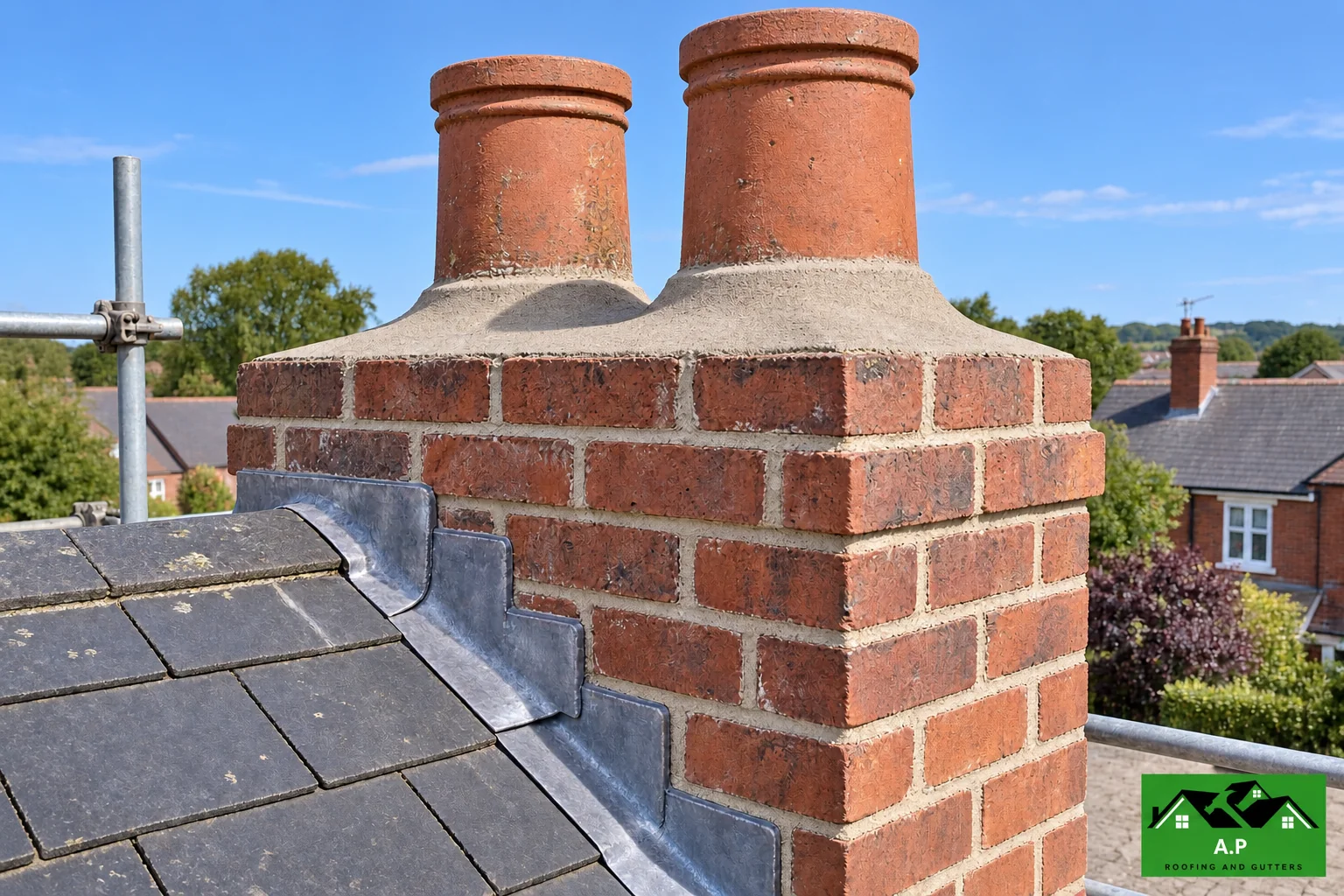
Repointing replaces deteriorated mortar joints so masonry can shed water and remain stable. On roofs and chimneys it is particularly exposed to wind, rain and freeze-thaw cycles, which is why shallow cosmetic pointing often fails quickly.
We carry out roof-related repointing around Crawley on chimney stacks and masonry details, with the repair material chosen to suit the existing brick or stone.
When repointing is actually needed
Open joints, deep erosion, loose mortar and vegetation growth can justify repointing. Hairline surface crazing or a colour difference alone does not always mean the whole area needs raking out.
We look at how deep the deterioration runs and whether water is entering behind flashing or through another nearby defect.
Raking out properly
New mortar needs enough depth and clean joint surfaces to bond. Smearing a thin layer over loose old material creates a fragile edge that soon flakes away.
Care is also needed around soft historic brickwork because aggressive grinding can widen joints and damage the arrises.
Choosing compatible mortar
Mortar should suit the strength, porosity and age of the masonry. Historic England emphasises compatibility when repairing older fabric because an overly hard repair can force moisture and movement into the bricks or stone instead.
That does not mean every chimney automatically receives the same lime mix; the existing material and exposure still need assessment.

Repointing alongside leadwork
Chimney flashings are often fixed into bed joints. If pointing around those details has failed, leadwork and masonry repair should be coordinated so neither trade undoes the other.
The top of the stack and flaunching should also be inspected before assuming water is entering through side joints alone.
Tell erosion apart from movement
Open mortar joints can let water in, but cracking may also indicate that masonry or roof components are moving. The repair needs to address the cause. A loose ridge tile should not be treated as sound simply because new pointing is applied around it. On a chimney, stepped cracks, leaning or displaced brickwork may require a broader assessment. We inspect the surrounding material and determine whether the job is local repointing, rebedding, brick replacement or a more substantial repair.
Preparation and curing affect the result
Failed mortar needs to be removed carefully enough to leave sound joint surfaces without unnecessarily damaging adjacent bricks. The chosen mortar should suit the existing masonry and exposure. Weather conditions influence how it is applied and protected while curing. Very hard replacement mortar is not automatically more durable on soft historic brickwork. Matching the joint profile and a sensible colour helps the repair sit naturally, but compatibility and a proper bond matter more than a freshly uniform appearance.
Combine the right work while access is available
Chimney repointing often provides an opportunity to inspect flaunching, pots and leadwork. These should remain identifiable parts of the quote. Renewing all the pointing will not stop a leak caused by an open back gutter, and new flashing will not stabilise failing masonry. A coordinated repair prevents one unresolved detail undermining the others.
Questions homeowners often ask
Yes if deterioration is genuinely local, although exposed elevations often weather differently so the whole stack should be inspected.
No universal answer applies. The mortar should be compatible with the masonry. Very hard mortar can be unsuitable for softer historic brick, while modern masonry may have different requirements.
Only if defective joints are the cause. Flashing, flaunching, pots, condensation and internal flue conditions can also contribute.
Technical guidance and further reading
What affects the size and cost of the job?
Chimney, pointing and leadwork jobs are often small in area but detailed and access-sensitive. Height, scaffold requirements, the condition of masonry and the complexity of flashings or weatherings can matter more than the quantity of raw material.
- Height and safe access around the stack or abutment
- Condition of brick, stone and existing mortar
- Extent and type of existing leadwork
- Need to coordinate pointing, flaunching and roof-covering repairs
- Complex corners, back gutters, valleys or dormer details
- Requirement to match older or heritage materials
A quote you can actually compare
The scope should separate masonry repair from leadwork and roof-covering work so you can see what is actually being renewed. Where lead is replaced, the detail and area should be described rather than treated as an unspecified strip of metal.
We prefer defined scopes to vague allowances. If an important part of the roof cannot be confirmed until material is lifted, that uncertainty should be explained before work begins rather than appearing as a surprise at the end.
What we inspect and work on
Chimney joints
Small masonry repairs
Traditional mortar details where appropriate
Ridge and verge mortar assessment
Preparation before repointing
Related roofing services

More questions about this service
Is repointing the same as rebedding ridge tiles?
No. Repointing renews exposed joints; rebedding involves lifting and setting units onto a sound bed or using an appropriate fixing system. Loose ridge tiles need an assessment of their support and fixing.
Can new mortar go over the old surface?
A thin covering over loose or eroded mortar is unlikely to provide a durable repair. Preparation must reach suitable material and create enough depth for the replacement to bond properly.